THE BELLOWS
A lens on a folding front
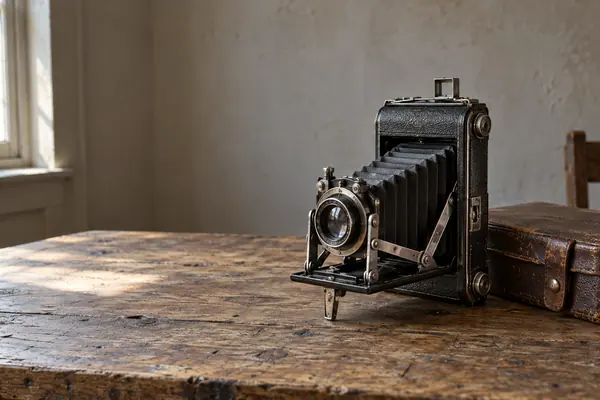
Museum records call them folding bellows cameras: the lens sits on a front panel that pulls out on bellows. One c.1935 model is listed as a drop-base, pull-out type.
How to read one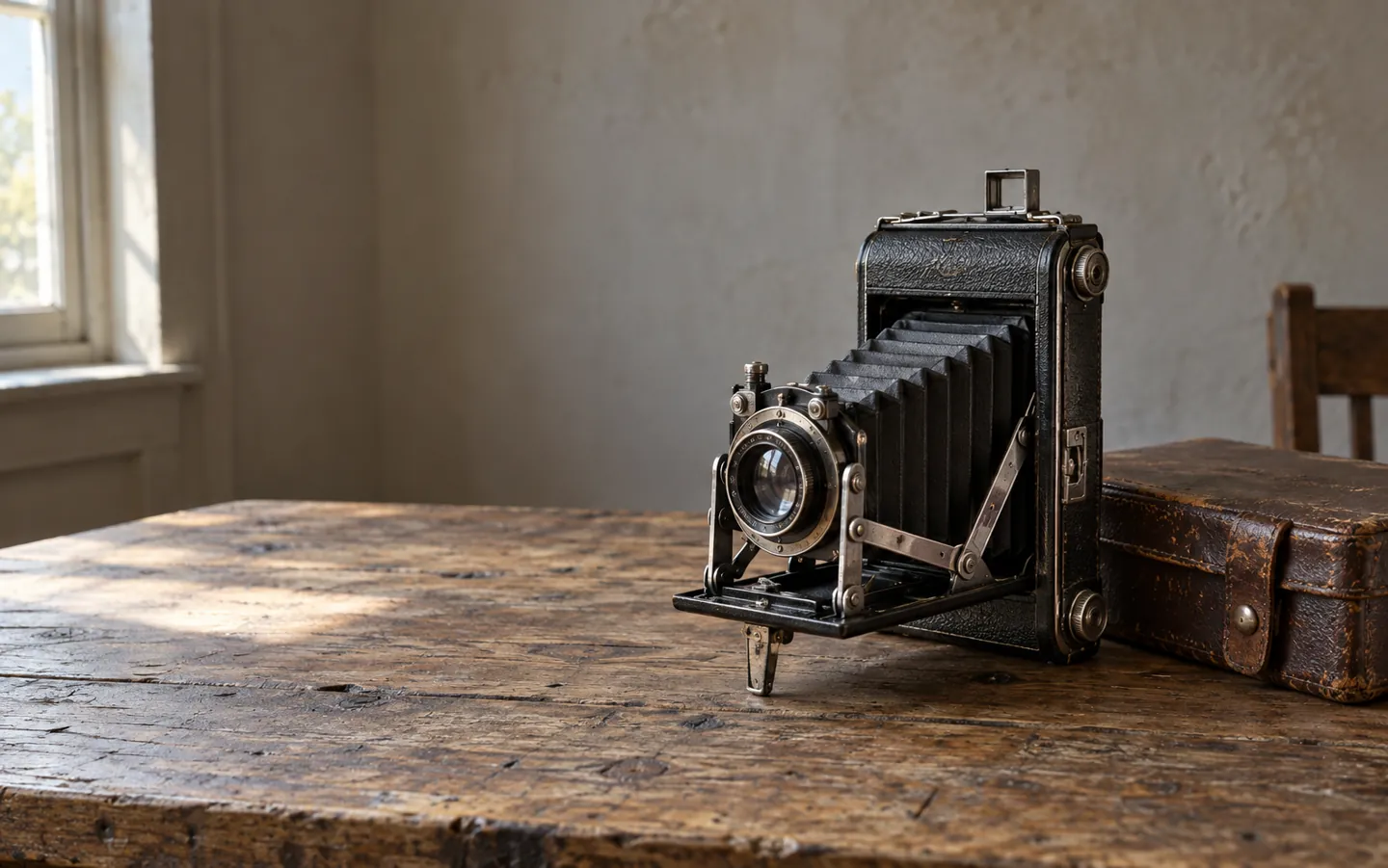
 foldercamera
FROM THE MUSEUM RECORDS
2¼ × 3¼ in on 120 roll film
Pull down the front, and the lens comes out on its bellows.
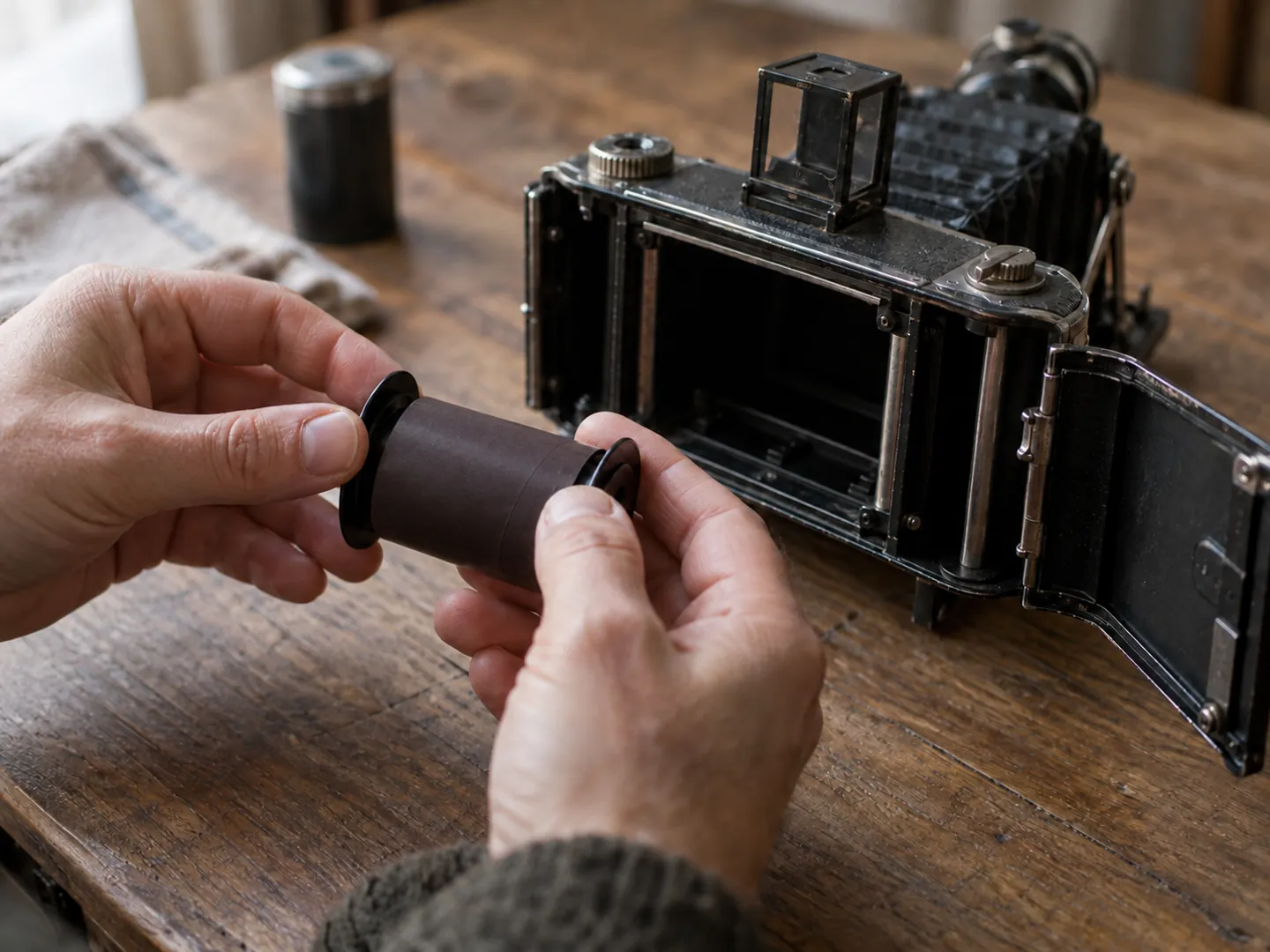
A folding camera keeps its lens on a front panel that pulls out on bellows and folds back into the body when you are done, so a camera taking large roll-film negatives fits in a pocket. These cameras carried snapshot photography through much of the 20th century, and museum catalogue records show what to look for on one: the film it takes, its lens, its shutter, how it focuses and how you aim it.
Updated
Check a film sizeTHE SHORT ANSWER
The design folds the lens away when you are done.
The film does the rest.
THE BELLOWS
Museum records call them folding bellows cameras: the lens sits on a front panel that pulls out on bellows. One c.1935 model is listed as a drop-base, pull-out type.
How to read oneTHE FILM
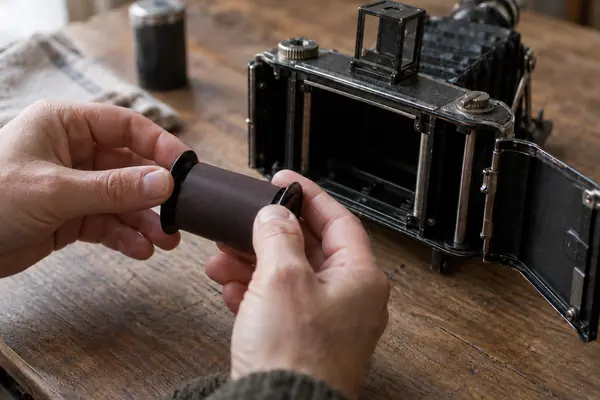
Many folding cameras took 120 roll film for 2¼ × 3¼ inch pictures. Some earlier models took larger 122 film, and some plate cameras added a roll-film back.
Check a film sizeTHE SNAPSHOT
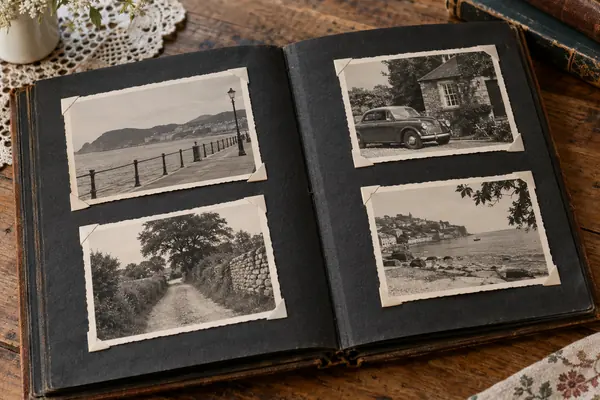
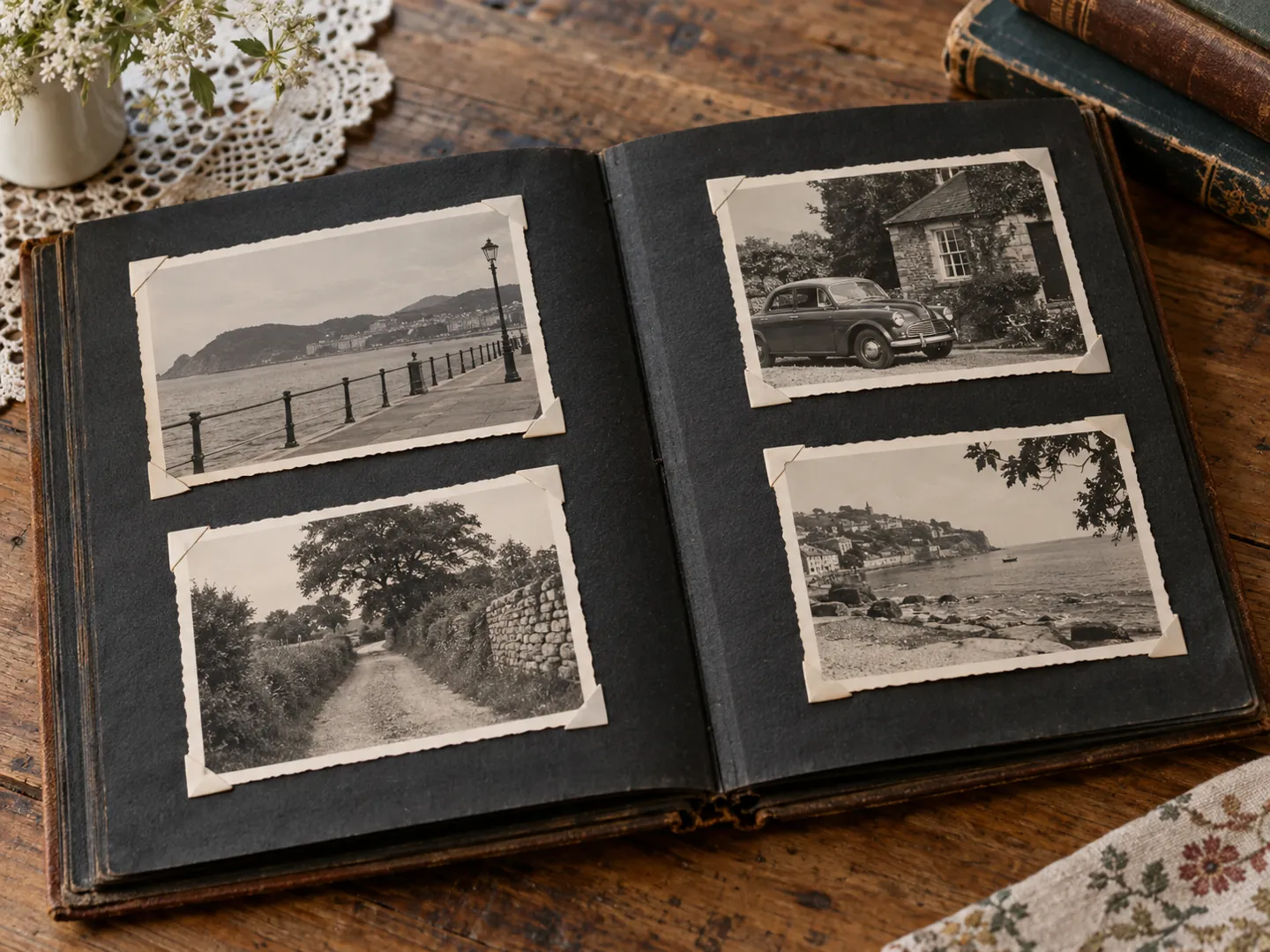
The Met says most snapshots from the 1890s to the 1950s were destined for the family album, recording holidays, gatherings, pets, cars and houses.
See the numbersA QUICK FILM CHECK
Pick a film or plate type from a museum record to see the picture size it gives. The bar shows how large that negative is compared with the others here.
Based on Science Museum Group Collection catalogue records for folding cameras.
TWO NUMBERS WORTH KNOWING
One estimate from the snapshot boom,
one from a museum review a century later.
1.5 million+
Roll-film cameras with amateurs by 1898
The Met says that by 1898, ten years after the 1888 box camera that launched the snapshot craze, one photography journal estimated over 1.5 million roll-film cameras had reached amateurs.
THE BOOM · THE MET
2,128
Cameras studied in one collection review
The Science Museum Group reviewed 2,128 cameras from an old exchange scheme and kept about 500, from folding roll-film cameras to box cameras, dating from the early 1900s to the 1980s.
THE REVIEW · SCIENCE MUSEUM GROUP
The 1888 box camera came loaded with a 100-exposure roll of film; when it was finished, the whole camera went back to the factory to be reloaded, according to The Met.
FOUR THINGS TO LOOK FOR
Museum catalogue entries describe each folding camera in the same order. These are the features they note.
Records give it first, such as 120 roll film for 2¼ × 3¼ inch pictures, or 9 × 12 cm plates.
Simple cameras had a meniscus lens; others list an achromatic or rapid rectilinear lens, sometimes with an iris diaphragm.
Look for the speed markings: one 1915-16 camera lists 25 and 50 plus B and T, while a 1920 plate camera runs from 1 to 1/200.
Focusing may slide, use click stops at 100 and 8 feet, or a rack and pinion. Finders range from a waist-level reflecting finder to a ground glass screen.
WHY THEY MATTER
The Met describes how roll film and small, fixed-focus cameras made photography accessible to millions of casual amateurs with no professional training. Snapshots recorded weddings, holidays, picnics, children, pets, cars and houses.
The Science Museum Group's review found cameras with handwritten notes and receipts, including a birthday message from 1959 inside one case, showing how personal these objects were to their owners.
Questions
A camera whose lens sits on a front panel that pulls out from the body on bellows. Science Museum Group records call them folding bellows cameras, and list one c.1935 model as a drop-base, pull-out type.
Quite flat. A 1930 folding camera in the Metropolitan Museum of Art, a version of a self-erecting folding model, measures 9.5 × 21 × 4.1 cm closed and weighs 0.8 kg.
Many took 120 roll film for 2¼ × 3¼ inch pictures. Museum records also list 122 roll film for 3¼ × 5½ inch pictures, and folding plate cameras for 9 × 12 cm plates.
The Science Museum Group collection records folding roll-film cameras from the early 1900s onwards, including one made between 1903 and 1908 and another from about 1935.
Through a small finder. The c.1935 camera in the Science Museum Group collection has a waist level finder attached to its lens panel; others list a rotating reflecting finder or a ground glass focusing screen.
Very. The Met says a photography journal estimated that over 1.5 million roll-film cameras had reached amateurs by 1898, ten years after the first one.
Sources
ABOUT THIS NAME
foldercamera.com is part of the DoodleSale portfolio. It isn't in an auction right now, but you can ask about leasing it.